
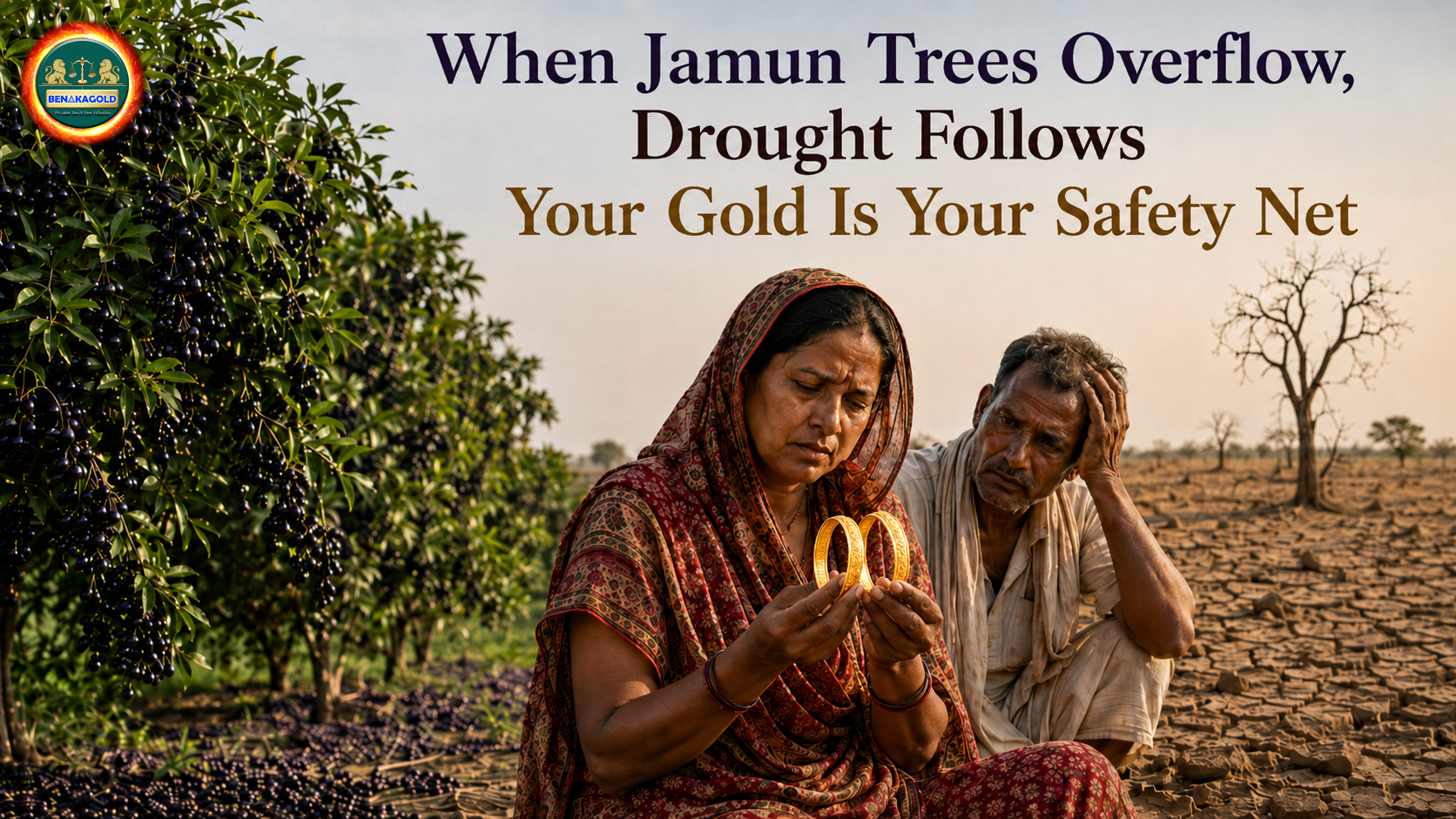
Walk through any village in Karnataka, Andhra Pradesh, Telangana, or Maharashtra right now and look at the jamun trees. Every branch bends under the weight of deep purple fruit. Markets overflow. Vendors cannot clear their stock fast enough. Farmers describe it as the heaviest jamun harvest they have witnessed in nearly 40 years and the moment they say that, the elders in every village nod quietly and say the same thing they have always said: drought is coming. This ancient belief is not superstition. It is observation built across generations and in 2026, science has validated every word of it. More importantly, it carries a direct financial message for every Indian household that holds physical gold. Gold is your safety net and nature itself is telling you this is the season to use it wisely.
Here is the full history behind this belief, how it works, why science agrees, and what it means for your gold right now.
Every year without exception, jamun trees enter their flowering cycle between March and April. For those flowers to survive, pollinate, and mature into fruit, they need one non-negotiable condition dry weather. Rain during flowering knocks blossoms off branches. Moisture during pollination prevents flowers from completing their cycle. So when January, February, and early March pass with low rainfall, depleted soil moisture, and dry warm air meaning the earth is already running desperately short on water jamun flowers survive in enormous numbers.
The tree senses something far deeper than just surface dryness. A jamun tree with declining water access in its root zone, falling groundwater beneath its taproot, and reduced soil moisture across its entire feeding area reads these conditions as a long-term existential threat. It does what every living organism under survival pressure does — it reproduces with urgency. It channels every biological resource into creating as much fruit and as many seeds as possible, pushing them into the ground before conditions deteriorate beyond recovery.
The result is a bumper harvest. Not a good season an overflow. Branches bent to breaking. Prices are crashing in markets. Vendors unable to sell what the trees keep producing.
Our grandparents watched this cycle repeat across four, five, six decades. A heavy jamun season always follows a dry pre-monsoon. That dryness always pointed toward a weak or failing monsoon ahead. They connected the fruit on the branch to the rain that would not come and they made financial decisions accordingly. ensured their families held assets that would not fail when the rains did. They ensured gold was their safety net before they ever needed to reach for it.
Jamun alert: Gold is your safety net, here is the science behind it
Jamun alert: Gold is your safety net, here is the science behind it
Scientists today formally describe what India’s elders observed for centuries as stress fruiting or masting a biological survival mechanism in which trees under environmental pressure produce an abnormally large quantity of fruit and seeds.
When a jamun tree detects declining groundwater through its root system, registers reduced soil moisture across its feeding zone, and experiences dry conditions during its critical flowering window, it triggers an emergency reproductive response. It reads the environment as hostile to long-term survival and floods its branches with fruit — ensuring seed dispersal across the widest possible area before conditions worsen further.
The science maps directly onto every word the elders passed down:
- Dry January to March → ideal jamun flowering conditions → superior pollination rates
- Superior pollination → record fruit set → bumper harvest visible to every eye in the village
- That same dry pre-monsoon period → depleted groundwater and soil reserves
- Depleted reserves → water-stressed landscape entering monsoon season
- Water-stressed landscape → any monsoon shortfall hits with amplified severity
The tree does not predict the future. It reports the present and the present it reports is always the same present that precedes drought. Your grandmother was not guessing. She was reading a biological instrument that has never given a false reading across the generations she trusted it.
And the financial decision she drew from that reading was always the same: make sure gold is your safety net before the dry season becomes a crisis season.
Gold Serves as Your Safety Net IMD Has Now Verified the 2026 Drought
The jamun trees delivered their message in March. The India Meteorological Department confirmed it in May and the numbers leave no room for comfortable doubt.
India’s 2026 southwest monsoon forecast stands at just 90% of the long-period average, placing it firmly in the below-normal category. The IMD has assigned a 60% probability of outright deficient rainfall across most of the country’s agricultural heartland meaning more than half the probability space now points toward conditions that qualify as drought by every official measure.
June 2026 has already delivered one of the weakest monsoon openings since 1901. The southwest monsoon arrived late this year, stalled for nearly 11 consecutive days after onset, and has still not covered Uttar Pradesh, large parts of Madhya Pradesh, and Gujarat — states that produce a critical share of India’s kharif food output. IMD records confirm that only a handful of years since the department began keeping data have produced a weaker June opening than this one.
El Niño conditions are developing with a 92% probability between June and September 2026 the identical climate driver that produced devastating droughts in 2002, 2009, and 2015. Every one of those years reshaped how millions of rural families managed their finances. Every one of those years sent families across India to trusted gold buyers to convert jewellery into the liquidity they needed to survive.
Mumbai’s seven supplying reservoirs sat at just 10.35% of total capacity by mid-June — roughly 40 days of drinking water for 13 million urban residents. When a city of that size sits 40 days from a water crisis at the start of the monsoon season, the word drought stops being a forecast and starts being a description.
The jamun trees read this in March. Science explained it in April. IMD confirmed it in May. June is living proof. Every signal points toward the same financial truth that India’s grandparents understood without a single data point: when the season turns against you, gold is your safety net and the time to activate it is before the season forces your hand.
Gold Is Your Safety Net – Drought And Gold Have Always Been Typical Siamese Twins In India
This relationship between drought years and gold selling is not a pattern invented for 2026. It is one of the most consistent and documented financial behaviours in India’s rural economy, repeating without exception across every significant monsoon failure in living memory.
India’s rural economy breathes with the monsoon. A strong season produces good harvests, higher farm income, surplus household cash, and consumer confidence that flows outward into weddings, festivals, and gold purchases across villages and small towns all the way through the post-harvest festive season. Every link in that chain depends on rain arriving on time and in sufficient quantity.
A failed or deficient monsoon reverses every one of those flows simultaneously. Seeds for the next sowing cycle must still be purchased even when the last harvest produced nothing worth selling. School fees arrive in June and July regardless of what the fields produced in April and May. Medical expenses do not pause for crop failure. Food costs money at market price when fields produce nothing at harvest.
In these moments moments that arrive in every drought year, in every agricultural state, across every income level of rural India families reach for the one asset that holds its value when every other financial resource has weakened or disappeared. Physical gold. The chain has been stored since grandmother’s time. The bangles were kept in the locker after a daughter’s wedding. The coins bought in a surplus year as a deliberate buffer against a bad one.
During India’s severe 2009 drought, when the country received only 77% of its long-period average rainfall, rural gold selling surged across Maharashtra, Karnataka, Andhra Pradesh, Telangana, and every major agricultural state. Families converted inherited jewellery and saved gold into working capital using it to fund the next crop cycle, clear urgent debts, keep children in school, and cover medical costs that could not wait for a better season.
The same pattern played out in the droughts of 2002 and 2015. Gold did not fail these families when everything around them did. It absorbed the shock of failed harvests and gave millions of households exactly the liquidity they needed to survive the crisis and begin rebuilding. That is precisely what a safety net is designed to do and that is exactly what gold is your safety net means in practice, not just in theory.
Protect Your Wealth with Gold The Importance of Taking Action Immediately to Avoid the Drought
Here is the financial reality that separates families who come out of a drought season financially stable from the ones who come out weakened and it comes down entirely to timing.
Families who assess their gold early in a drought cycle before financial pressure builds, before crop failure is confirmed, before the urgency of unpaid bills enters the room sell gold at the live market rate with complete confidence and full negotiating composure. They make a deliberate, planned financial decision on their own timeline. They walk away with working capital that they fully control, at a price that reflects market strength rather than personal desperation.
Families who wait until crop failure deepens, loan repayments fall overdue, and school fees reach their final deadline make distress sales. The gold price itself may not have fallen but the personal financial urgency that surrounds that sale weakens every dimension of the outcome. Selling under pressure never produces the best result, even when the underlying asset remains strong.
Gold prices in India remain near historic highs in rupee terms today. The MCX spot price reflects sustained global safe-haven demand, active central bank buying across multiple countries, and a rupee that continues trading weak against major world currencies. The market is not at its absolute peak of early 2026 but it is closer to that peak than at any point in the previous decade. Families who sell today capture genuine market strength.
The window to activate your safety net on your own terms is open right now. Every week the monsoon underperforms narrows that window further.
Gold Is Your Safety Net Benaka Gold Company Turns It Into Immediate Cash
Benaka Gold Company makes the process of activating your safety net simple, transparent, and fast, completed in under 15 minutes at every branch across South India.
Step 1 — Collect every piece of idle gold you own,
Old jewellery, broken chains, single earrings without pairs, inherited bangles, gold coins, bars every gram carries real market value at today’s live rate. No purchase receipt is required. A valid government-issued photo ID is the only document you need to bring.
Step 2 — Walk into your nearest Benaka Gold Company branch
Branches operate across Bangalore, Hyderabad, Vijayawada, Mysore, and major cities throughout South India. Every branch displays today’s live gold rate on a visible board at the entrance transparent from the moment you step through the door.
Step 3 — Transparent purity testing in front of you
Every piece you bring is tested using BIS-certified XRF machines non-destructive, chemical-free, and fully visible to you in real time. You see the purity reading on screen as it appears. Nothing happens behind a closed door or in a back room out of your sight.
Step 4 — Full calculation shown before any offer
Your payout = Net Weight × Purity Percentage × Today’s Live Market Rate. No melting fees. making charge deductions. No hidden margins applied without your knowledge. The complete calculation appears on paper or screen before you accept or decline any offer.
Step 5 — Spot payment the same day
Cash, UPI, NEFT, or RTGS your preferred payment method, processed within minutes of your offer acceptance. Every transaction receives a written receipt detailing weight, purity, rate applied, and total amount paid.
Gold Is Your Safety Net Use It Before the Drought Season Uses You
India’s grandparents read nature the way we read financial dashboards today. They watched jamun trees the way we check gold rate apps on our phones. They moved when the signals told them to move and they were right, season after season, because the signals never lied.
In 2026, every signal points in the same direction at the same time. The jamun harvest overflowed across South India in March. IMD confirmed a below-normal monsoon forecast in April and downgraded it further in May. June has already delivered one of the worst monsoon openings in over a century. The drought season is not a prediction anymore it is a reality that is deepening week by week.
Your gold sitting idle in a locker is a safety net folded up and unused. The decision is straightforward: activate it now, on your terms, at a price that reflects today’s genuine market strength or wait until drought pressure activates it for you, under conditions you no longer control.
Smart families across Karnataka, Andhra Pradesh, Telangana, and South India are already making this decision. Visit your nearest Benaka Gold Company branch today. Because gold is your safety net and the best time to use a safety net is before you are already falling.
Further Reading
How to sell gold safely in Bangalore — complete guide
Where to sell gold and get the best price in India
What old gold buyers look for when valuing your jewellery
Leave a Reply