
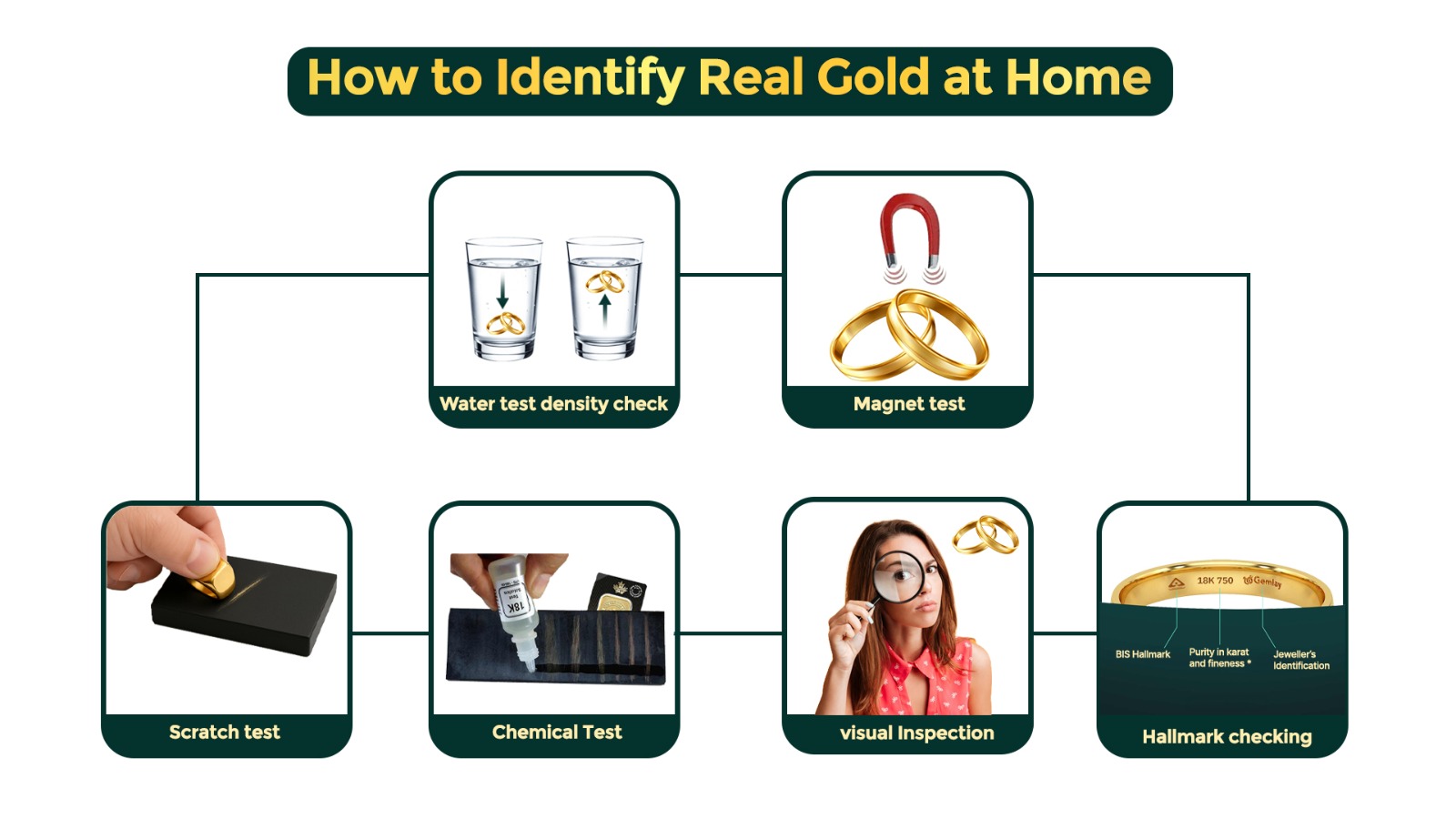
Whether it’s a heavy heirloom or a vintage find, that glint in your jewelry box often comes with a question: is it the real deal? Gold has always been the ultimate symbol of security, but looks can be deceiving. Learning how to perform a gold test is the best way to move past the guesswork and uncover the true value of your collection.
You do not need a lab or fancy gadgets to unlock the secrets of your gold. With a few clever tricks and household items, you can test your jewelry’s purity right at your kitchen table. This guide will show you the most trusted home-testing methods, so you can admire your collection with newfound confidence.
Why Testing Gold Matters
Gold is not only used for jewelry; it is also an investment. Knowing the purity of your gold allows you to determine its true market value. If you plan to sell or exchange your jewelry, understanding whether it is 22K, 18K, or a lower purity helps ensure you receive a fair price. Counterfeit and gold-plated items are common, and without proper knowledge, it is easy to be misled.
Learning basic inspection techniques helps protect you from fraud and gives you a clearer understanding of your assets.
The First Step: Check for Hallmarks
Before you look for things around the house to test your jewelry, check the metal itself first. The most reliable clue is often a stamp called the “Hallmark.”
Use a magnifying glass to check the inside of a ring or the clasp of a necklace. Look for small stamps indicating the gold’s purity. In many countries, including India, the Bureau of Indian Standards (BIS) certifies gold. A BIS hallmark is a trusted sign of quality.
When you find a stamp, check for the BIS logo and the purity grade. You might see numbers like “22K916” or just “916.” This number is important because it shows how pure the gold is. For example, 916 means the gold is 91.6% pure, which is 22 Karat. Most high-quality jewelry uses this standard.
If you notice marks like “GP” for Gold Plated or “GF” for Gold Filled, the item is not solid gold. It just has a thin layer of gold over another metal. Looking for these stamps is the simplest and safest way to begin checking your jewelry.
The Magnet Test: Gold is Not Magnetic
Gold is not magnetic, which is one of its basic scientific properties. If you have a strong magnet at home, preferably stronger than a fridge magnet, you can try this simple test.
Put your gold item on a flat wooden or plastic surface. Slowly move the magnet closer to it and watch what happens. If the jewelry sticks to the magnet or is pulled toward it, it is probably not real gold. It may have iron, nickel, or steel under a layer of gold plating.
Real gold will not move at all. Keep in mind, though, that this test is not perfect. Some fake metals are also non-magnetic, so use this as an initial check, not a final answer.
The Water Gold Test: Checking Density
Gold is a dense, heavy metal. One simple way to check this is by using a glass of water, a method called the “float test.”
Fill a glass or a bowl with water, and gently drop your gold item into it. Real gold will sink straight to the bottom. If it floats or stays in the middle, it is probably fake or just gold-plated plastic.
Real gold will not rust or tarnish when it gets wet. If you see any discoloration after soaking the item, it likely contains other metals.
The Vinegar Test: A Chemical Reaction
If you want to try a slightly more advanced method, you can use ordinary white vinegar. Gold is a noble metal, so it does not react easily with weak acids such as vinegar.
Put your jewelry on a paper towel and add a few drops of white vinegar to the metal. Watch what happens. If the metal changes color, turning black, green, or cloudy, it is probably not real gold. This reaction means the acid is breaking down a less expensive metal.
If the vinegar does not change the color of your gold, your jewelry has passed the test. This method is quite safe, but you should always rinse your jewelry with water afterward to keep it clean.
Visual Inspection: Look for Wear and Tear
Often, your eyes are your best tool. Take a close look at the jewelry, especially at areas that touch your skin or clothing, such as the edges of a ring or the clasp of a chain.
If you notice another color under the gold, like silver or copper, it means the piece is gold-plated. Over time, the thin gold layer can wear away, revealing the metal underneath. Real gold maintains its color throughout, even if it gets scratched or worn.
Check if your skin changes color after wearing the jewelry. If you see a green or black mark on your finger or neck, the metal is likely reacting with your sweat. Real gold is hypoallergenic and almost never causes these marks.
Important: What You Should Avoid Doing gold test at Home
While home testing is helpful, some viral internet methods can permanently damage your jewelry and lower its resale value. To protect your gold, follow these five rules:
| NO “Burn Tests | Avoid using lighters or kitchen stoves. Flames create soot that is hard to remove. Extreme heat can also melt delicate links or clasps. |
| NO Harsh Chemicals | Stay away from bleach or chlorine. These can cause stress cracking, making your gold brittle and likely to break. |
| NO Deep Scratching | When testing on ceramic, use the lightest pressure possible. Deep scratches remove gold weight, which means a lower payout when you sell. |
| NO Bite Test | Biting gold is for the movies. It can damage your teeth and is dangerous because many fakes contain toxic lead under the plating. |
| NO DIY Acid Kits | Household environments are not made for handling Nitric Acid. These kits are dangerous to your skin and can permanently stain your jewelry if used incorrectly. |
When to Seek Professional Help
Home tests are great for a quick check, but they have their limits. They can show if something is fake, but they usually can’t tell you the exact purity. For instance, the vinegar test might confirm it’s gold, but it won’t say if it’s 14K or 18K.
If you have a piece that is potentially valuable, or if you are planning to sell, you need precision. This is where professional evaluation comes in. Advanced technology, like X-ray fluorescence (XRF) machines used by professionals, can determine the exact elemental composition of your jewelry without damaging it.
If you need to sell your gold, trust Benaka Gold ISO-certified gold buyer.
Figuring out gold purity should not be a risky or uncertain process. When you decide to sell gold, you should know exactly how your gold is valued, with no hidden fees or unclear appraisals.
At Benaka Gold Company, our reputation is built on ISO-certified transparency. As an ISO-registered gold buyer, we follow strict international standards for quality and fairness. We use advanced technology to show you exactly what you own, not just weigh your gold.
Our evaluation process is completely open and honest, so you get the best value for your gold without any confusion. Whether you have broken jewelry, gold coins, or family heirlooms, we offer a safe, professional, and certified place to sell your gold with confidence.
Secure your wealth with confidence. Step into Benaka Gold Company for a trusted, professional assessment that meets the highest ISO standards.
to know more about gold read out our latest blog at blog.benakagoldcompany.com
FAQs
Put a small drop of vinegar on your gold item. If it’s real gold, the color will stay the same. If it’s fake, it might turn green or get tarnished.
Yes. If you drop your gold into a bowl of water, pure gold will sink quickly because it is dense. If it floats, it probably contains other metals.
Yes, you can. Gold is not magnetic, so if your piece sticks to a magnet, it probably contains other metals and is not pure gold.
The acid test uses nitric or hydrochloric acid. Put a small drop on your gold. If there is no reaction, your gold is probably pure. Be careful, though, as this test can damage your item.
A gold testing kit usually comes with acids and a testing stone. Scratch your gold on the stone, add some acid, and watch how it reacts to check the purity.
Usually, you can. Check for stamps like 10K, 14K, 18K, or 24K. Keep in mind that stamps can be faked, so it’s a good idea to use other tests too.
Mix salt and water to make a solution. Drop your gold in. If nothing happens, your gold is probably real. Be careful, though, because this test can damage some items.
Yes. Weigh your gold and figure out its density by dividing its weight by its volume, which you can find by submerging it in water. Then, compare this number to the density of pure gold.
Leave a Reply