
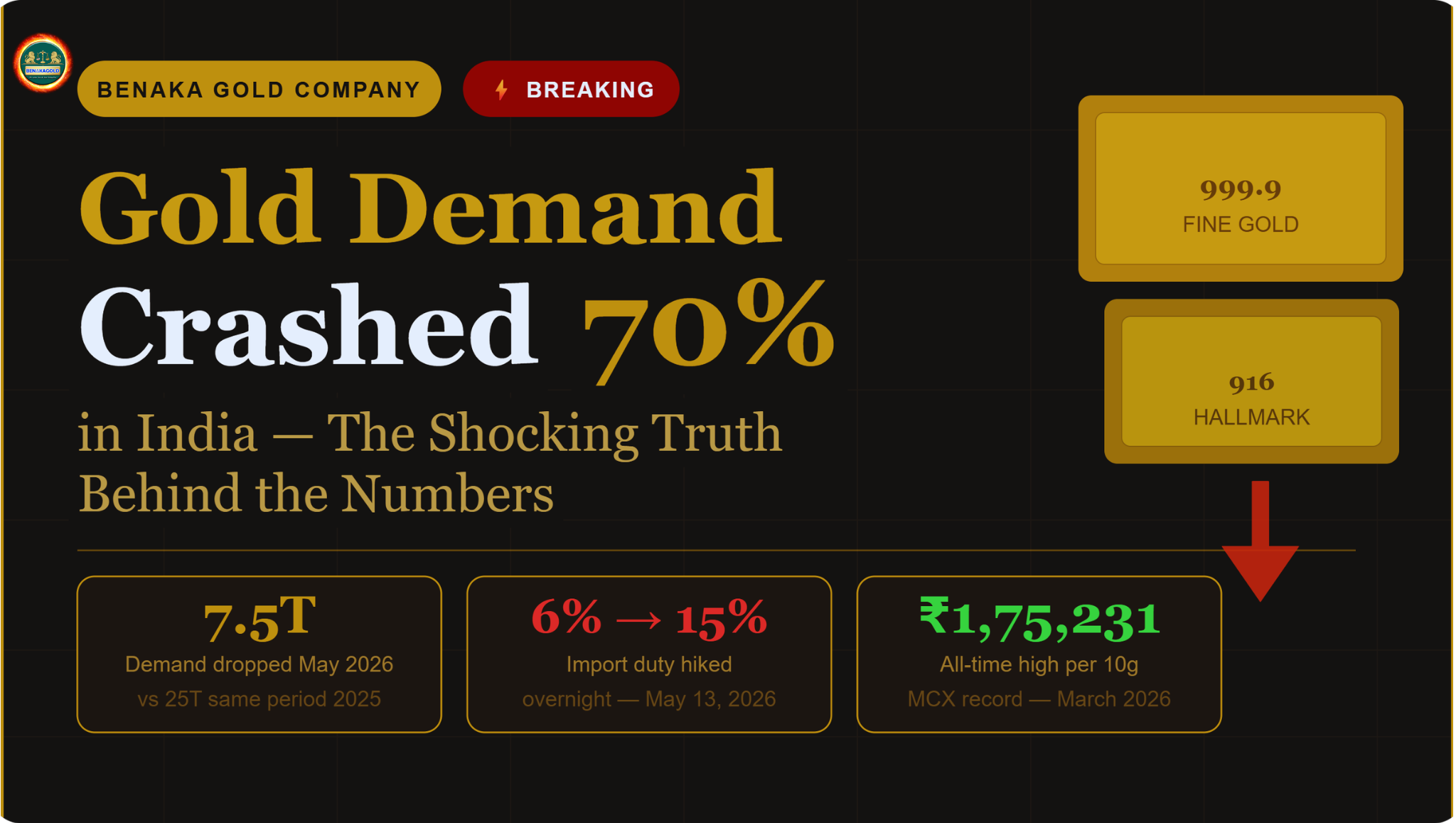
If you follow the gold market, you are likely aware that gold demand in India is quite resilient. As the world’s second-largest gold consumer, gold plays a significant role in Indian weddings, festivals, savings, and cultural identity. Therefore, when gold demand plummeted by 70% in just two weeks, the entire bullion industry took notice. This blog will explain what happened, why it occurred, and most importantly, what it means for you if you currently own gold jewelry and are contemplating your options.
What the 70% Crash in Gold Demand Actually Means
Let’s start with the raw numbers, because they are genuinely shocking.
According to the India Bullion & Jewellers Association (IBJA), gold demand in India fell to approximately 7.5 tonnes in the fortnight ending May 27, 2026. Compare that to 25 tonnes during the same fortnight in 2025 that is a drop of nearly 70% in just one year.
To put it plainly, gold buying in India nearly collapsed within a matter of days.
Surendra Mehta, National Secretary of the IBJA, stated publicly that reports from jewellers across India confirm this dramatic decline, and that the unorganised trade segment — which accounts for 65% of India’s gold market has been hit the hardest.
These numbers did not come out of nowhere. They are the result of not one but three simultaneous shocks hitting the market at the same time.
The Three Causes Behind the Crash in Gold Demand in India
Reason #1 – The Import Duty Shock
On 13th May 2026, Government of India increased the tariff on gold imports from 6% to 15%. This was the single biggest hike in duty on gold in recorded history of India – a 9 percentage point hike in one notification.
The government’s rationale was straightforward: India’s currency had depreciated more than 7% so far this year and gold imports had skyrocketed to an all-time high of $71.98 billion in FY2025-26, up 24% from the previous year. Gold constituted over 10.8% of the country’s total import bill of products. With the current account deficit expanding and FX reserves under strain, the government employed the gold import tariff as the most direct policy tool.
The initial retail fallout was brutal. Gold prices in the national capital touched ₹1,56,800 per 10 grams on May 13, a ₹1,500 increase within hours of the notification. Jewellery stocks fell sharply:
Reason #2 – The Prime Minister’s Appeal
Prime Minister Narendra Modi had made an extraordinary public appeal a few days before the tariff hike while addressing a public rally in Secunderabad. He appealed on Indian families to voluntarily abstain from buying gold, especially during weddings, for at least a year as a patriotic move to protect the nation’s foreign exchange reserves, in the wake of the ongoing West Asia conflict and the surge in crude oil prices.
It was not a legal ban. But in India, where political and moral authority carries immense cultural clout, the Prime Minister’s statements hit deeply. Consumer sentiment, already shaken by record high prices for gold, was affected again. Walk-ins have fallen dramatically in the days after the speech, jewellers countrywide said.
Reason #3 – Record prices that took mass-market buyers out of the picture
Even before these two disasters, India’s gold demand was already under pressure. In Q1 2026, the MCX spot gold price averaged ₹1,51,108 per 10 grams, up 81% YoY. The price hit an intraday lifetime high of ₹1,75,231 per 10 grams in March 2026.
Mass-market consumers, the traditional backbone of gold-buying culture in India, were already retreating at these levels. Jewellery volumes declined 19% YoY in Q1, the second lowest number since 2000, while jewellery purchasing value jumped 47% due to increased pricing.
Gold was not something to access, but something to aspire to. Then the tariff hike and PM Modi’s plea on top of that.
The Structural Shift Rewriting Gold Demand in India
The 70% drop in demand is immediate, but something deeper is shifting in the way Indians react to gold. The World Gold Council’s statistics for Q1 2026 indicate a structural rotation that analysts are referring to as a generational inflection point.
For the first time in the Indian market’s historical records, investment demand exceeded jewellery demand, accounting for approximately 70% of total gold demand in Q1 2026. Bar and coin demand alone was 62 tonnes, almost equalling the 66 tonnes of jewellery demand. Gold ETF inflows up 197% y/y on record
This means the India of 2026 is a different India from the India of 2016, as far as gold is concerned. Gold ETFs and Sovereign Gold Bonds are finding favour among younger Indians living in cities, who prefer actual jewellery. The physical market, home to most of your inherited necklaces, bangles, and chains, is structurally shrinking.
If you have physical jewellery that has appreciated substantially over the last five years, the question you need to ask yourself is: does it make more sense to store it in a locker, or turn it into working capital at a time when prices are reaching record highs and physical demand is cooling?
What This Means for Sellers: Why Gold Demand in India Crashing Is Your Signal to Act
If you are reading this because you have gold in your house, this is the most important part for you.
If demand for gold in India declines drastically, it is simple to mistake the signal and think: ‘prices will fall too so I should wait’. But there is a catch to that logic.
Gold prices are not decided only by Indian domestic demand. The base price is determined by the worldwide price of gold set by international investors, central banks, and geopolitical risk. India’s import duty and domestic demand influence the local premium on top of that, but do not collapse the global price.
Central banks around the world continue to buy gold at levels close to records. The World Gold Council’s outlook for 2026 affirms that gold prices will remain supported internationally through 2026 by geopolitical risk premiums, safe-haven demand, and investment flows.
This 70% demand drop does this: it kills off the domestic buying pressure that would have pushed prices up much higher. It does not remove the fundamental global price floor.
For sellers at Benaka Gold Company, this turns into a real, concrete benefit. Every gram you sell today is paid at the actual market pricing, which remains at record highs despite the recent downturn. Same-day spot payment with full transparency on testing and calculation, and no hidden deductions.
The research indicates that if you’ve been waiting for the “right time” to turn idle jewellery into cash for a business venture, a child’s education, a medical bill, or a financial objective, that time is now, not later.
Frequently Asked Questions Gold Demand in India and What It Means for Sellers
Domestic demand is one factor, but global gold prices, rupee movement, and central bank buying are bigger drivers. Prices have corrected from their peak but remain at historically high levels.
Yes. Prices are still near record highs in rupee terms. Selling at current market rates through a certified buyer like Benaka Gold Company gives you one of the highest payouts in recent history. Read our detailed guide on how to sell gold in Bangalore safely and profitably for the full step-by-step process.
No. The import duty applies to new gold entering India. When you sell existing physical gold that you already own, the valuation is based purely on the weight, purity, and today’s live market rate — the duty hike does not reduce your payout.
A valid government-issued photo ID is sufficient. A purchase bill is helpful but not mandatory. For a complete breakdown of the process, visit Benaka Gold Company’s Bangalore gold selling guide.
Benaka Gold Company pays you cash for your gold’s actual gold content, at the live market rate, with no requirement to purchase anything new. Jewellery stores deduct making charges, impose exchange conditions, and tie your payout to a new purchase. There is no comparison.
The Bottom Line: Don’t Let the Headlines Confuse You
The headline ” gold demand in India dropping by 70% is aimed to scare. The true nature is more complex and more useful for anyone holding physical gold.
By historical standards, prices remain high. The global demand floor is still there. The duty hike helps the sellers as it sets the bar for the domestic price. And this opportunity for converting your gold at these rates won’t be open forever.
Visit your nearest Benaka Gold Company branch in Bangalore, Hyderabad, Vijayawada, Mysore, and other important cities in South India. Bring your gold. Get paid immediately at the live market rate, with complete transparency from testing to transaction.
For more on making smarter gold decisions, explore our guides:
- How to sell gold safely in Bangalore — full process guide
- Where to sell gold and get the best price
- How old gold buyers value your jewellery
Or visit the Benaka Gold Company homepage to find a branch near you and check today’s live gold rate.
Leave a Reply